.png)
How Much Does a Mobile Command Vehicle Cost in 2026?

Quick Answer (TL;DR)
Most mobile command vehicle conversions in 2026 cost between $60,000 -$150,000 from Next Gen Vans. This includes the vehicle and the conversion.
Typical new Sprinter 170WB AWD or a Box Truck range from $55,000-$80,000.
We can expect the combined average of vehicle + conversion to be $115,000-$230,000, depending on battery systems, off-road capability, and specialty equipment.
This guide explains what a mobile command vehicle is, how pricing works, and what to budget if you are planning a command, drone, SWAT, or CSI van with Next Gen Vans.
If you want to learn more you can schedule a call or reach out to info@nextgenvans.com

Contents

What is a mobile command vehicle?
Short answer: A mobile command vehicle is a fully equipped control room inside a van / box truck that lets your team coordinate wherever it is parked. It DOES NOT require the engine to be on.
Instead of relying on a fixed building, a command van gives you:
A climate controlled workspace
Secure communications and internet
Power for computers, monitors, radios, and drones
Storage for gear and paperwork
A quiet environment for long deployments
Options to include toilet, plumbing, shower, bed, microwave, fridge etc.
Yes, Next Gen Vans is the sister brand to Brooklyn Campervans, that builds the world's top of the line homes on wheels. Together they blend the latest technology with fine interior design.
Now back to Mobile Command vehicles. They are used for emergency response, public safety, drone operations, utilities, event security, and field inspections. They replace the old model of “big truck plus noisy generator” with something much more flexible and efficient.
Outside of drone operations and SWAT vehicles here are 26 ways a mobile office can help your mission.
Key takeaway: Think of a mobile command vehicle as a portable HQ that can park where the mission happens.

How much does a mobile command vehicle cost in 2026?
Short answer: In 2026, a professionally built mobile command vehicle is a bit more than a Mobile Office, and typically costs between 115,000 and 230,000 dollars, including both the van and the full conversion.
Here is a simple breakdown:
Type of mobile command vehicle | Typical total cost range |
Basic command van / truck | 115,000 – 170,000 |
Drone and command combo unit with large battery requirements | 170,000 – 200,000 |
Advanced tactical or multi role command | 200,000 – 230,000+ |
Cost varies based on:
Power system size and complexity
Internet and communications package
Number of workstations and monitors
Security and surveillance systems
Accessibility or ADA features
Interior materials and branding
Key takeaway: Most agencies see a serious, field ready command van as a six figure capital project, not a small upfit. The payoff is a long lasting platform that works as a core part of your operations.

What vehicles is best for a mobile command unit?
This really depends on the roads you'll need to navigate. Literally. For a small and versatile AWD vehicle, the Sprinter is the top of the line.
If space is more important to you, then going with a Unicell Box Truck is best. They can be the same length and height, but offer significant more interior space being a box.

How much does a Sprinter 170WB command van cost?
Short answer: A Sprinter 170WB AWD High Roof mobile command van usually ends up around 180,000 to 190,000 dollars when built to a modern standard.
Here is an example cost structure for a common configuration:
Base vehicle: Mercedes Sprinter 170WB AWD High Roof. Approximate cost: 72,000 dollars
Core infrastructure and power: Insulation, walls, floor, ceiling, wiring, outlets, lighting, HVAC, base battery, exterior graphics. Approximate cost: 57,000 dollars
Interior layout and seating. DOT track floor, swivel captain chairs, work surfaces, equipment mounts. Approximate cost: 13,800 dollars
Cabinetry and windows. Secure storage, overhead cabinets, drawers, insulated windows with shades, counters with integrated lighting. Approximate cost: 13,850 dollars
Technology and connectivity. Satellite internet, routers, monitors, video routing, drone charging capability, upgraded battery capacity. Approximate cost: 8,800 dollars
Miscellaneous and documentation. Freight, labeling, manuals, training and handoff. Approximate cost: 1,000 dollars
Total typical investment: Around 180,000 to 190,000 dollars
Key takeaway: If you are planning around a Sprinter 170WB AWD platform, budget near 180,000 dollars for a highly capable command or drone van with modern systems.

What factors affect mobile command vehicle cost?
Short answer: The main cost depends on battery requirements and off-road capability. Workstations are cheap.
A) Battery Systems
Command vehicles can charge in 4 ways with different battery sizing options. However, if you can plug it in and charge overnight, then you can go with the most basic option.
They can charge
Via Solar Panels
Via Driving - battery-to-battery alternator
Via Shore Power - being plugged
Via a Smart Generator

B) Off-road Capability
If you're looking for Suspension Upgrades, A/T Wheels & Tires, exterior storage and lighting, front bumper protection with a 12,000lb winch that can add up!\
C) Interior Craftsmanship
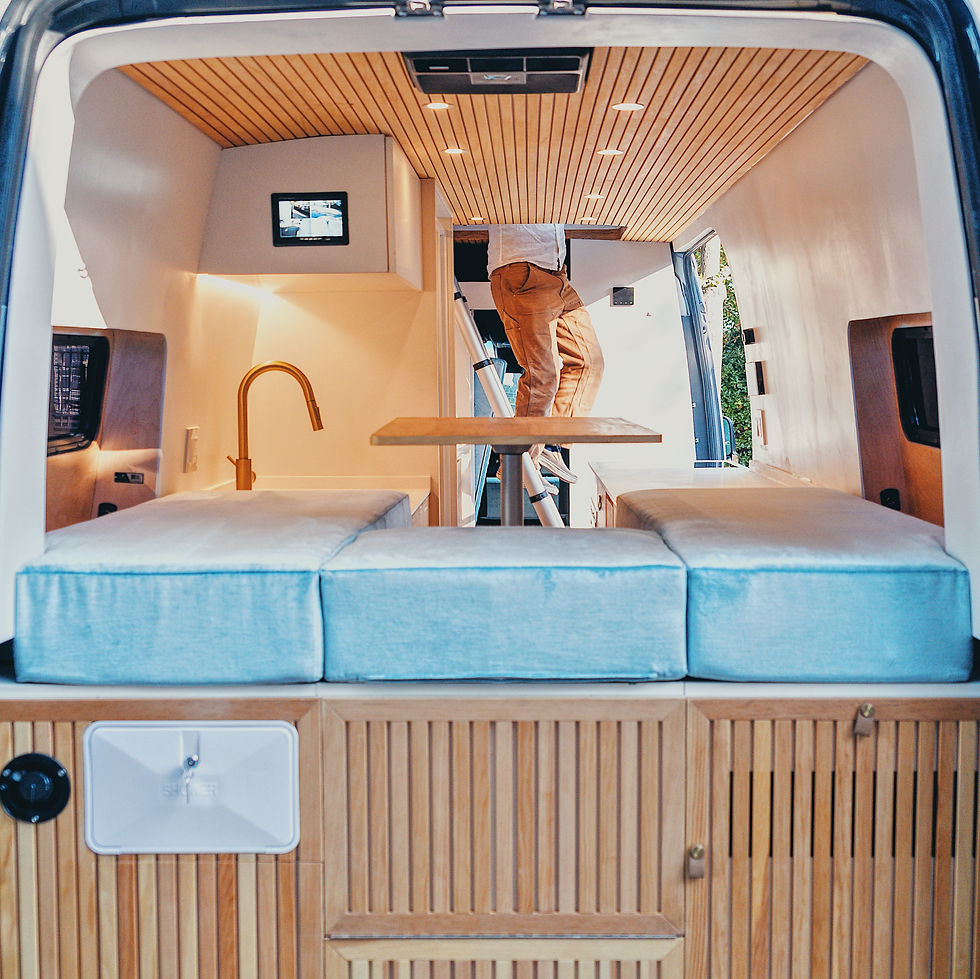
Next Gen Vans uses the best materials out there. However, Brooklyn Campervans takes it up a notch with the highest level of interior design and craftsmanship. If you want the vehicle to come straight out of a trendy Sci-Fi movie that we can do that with the right budget
D) Amenities
Security systems, indoor shower, bathroom, bullet proofing, or any professional equipment installation will be an additional add-on.
Key takeaway: Two vans can look similar from a distance but differ in cost by tens of thousands of dollars once you factor in power capacity, connectivity, and mission specific equipment.

What is the difference between a mobile command van and a drone command vehicle?
Short answer: A mobile command van is built for overall coordination. A drone command vehicle is built specifically to run and manage UAV operations.
Mobile command van focus
Acts as a central hub for communications and decision making
Hosts incident commanders, supervisors, and operators
Prioritizes seating, screens, and secure data handling

Drone command vehicle focus
Designed around drone launching, charging, and monitoring
Includes extra power for charging multiple UAV batteries
Uses multi screen setups for telemetry and live video feeds
Many agencies pair one primary command van with one dedicated drone van, especially for search and rescue, disaster response, and critical infrastructure inspection.
Key takeaway: If your operations rely heavily on drones, a separate drone command vehicle often makes sense for power, workflow, and safety.
What features are included in a modern command vehicle?
Short answer: Modern command vehicles include off grid power, high quality HVAC, robust connectivity, ergonomic workstations, and 360 degree awareness.
Common features in a Next Gen Vans build include:
Power and climate
Lithium battery banks sized for your use case
Multiple charging sources
48V air conditioning and efficient heat
Silent operation without idling
Connectivity
Cellular router with one or more carriers
Satellite internet with Starlink. Next Gen Vans modified it to 12v for minimal battery usage.
Signal boosting antennas
Private and guest networks

Interior and workstations
Swivel captain chairs and modular chairs mounted to L-Tracks
Modular desks and work surfaces
Wall mounted monitors
Lockable cabinetry and drawers
Security and monitoring
360 degree camera systems
Night vision options
Dashcam and digital rearview mirror
Exterior flood lights and scene lights

Comfort and usability
Acoustic insulation for quiet operation
Adjustable task and ambient lighting
Thoughtful cable management and labeling
Key takeaway: The best command vans feel like a small, quiet, well organized control room, not a noisy truck.
Who uses mobile command vehicles today?
Short answer: Mobile command vehicles are used by public safety, utilities, private security, media, and nonprofits.
Common users include:
Police departments and SWAT teams
Fire and EMS agencies
Emergency management offices
Public health and outreach programs
Utility and telecom providers
Event security and crowd management teams
Construction, engineering, and inspection firms
Environmental and advocacy nonprofits
Film, broadcast, and content production crews
Key takeaway: If your team needs to make decisions in the field with data, video, and communications in one place, a command van is a strong fit.

Are there grants or funding options for command vans?
Short answer: Yes. Many agencies use grants, capital improvement funds, or tax incentives to pay for mobile command vehicles.
Common public funding sources include:
Emergency management and homeland security grants
State or regional preparedness and resilience programs
Urban area and critical infrastructure protection funds
Public health and outreach grants when linked to services
Private and nonprofit buyers often combine:
Capital equipment budgets
Sponsorships or partnerships
Section 179 tax deductions where applicable (talk to your tax advisor)

Next Gen Vans can provide:
Detailed quotes for procurement
Layout diagrams and specifications
Documentation you can attach to grant applications
Key takeaway: Treat a command van like any other major infrastructure purchase and align it with a clear service or preparedness goal when applying for funds.
How long does it take to build a command van?
Short answer: Most mobile command vehicle builds take five to ten weeks once design is finalized and the van is on site.
Reach out to Next Gen Vans about Build Availablity.
Why choose a custom build from Next Gen Vans?
Short answer: Vehicles are custom built around your business needs with the latest technology and highest craftsmanship.
Power, internet, and HVAC are sized for real world duty cycles
Interior layout is tuned for your team size and equipment list. It is also modular, things can be removed, and vehicle can revert to being a cargo van.
Systems are labeled, documented, and supported
The van is built to grow with you, not lock you into a fixed configuration
Key takeaway: A properly designed command van becomes a core asset, not just another vehicle.
Email info@nextgenvans.com for more information

What should you define before starting a command vehicle project?
Short answer: The more clearly you define your needs, the better your final build will support your work.
Before you start, answer these questions:
What will this van do most days? Incident command, drone operations, CSI, inspections, outreach, or a mix.
How many people need to work inside at once? Two operators, four, or more.
How many road legal seats with seatbelts are needed? 2 or 4 passengers.
How long must the van operate off grid? A few hours, a full shift, or multiple days before being plugged into shore power.
Where will it be used most? Dense urban streets, rural areas, disaster zones, or remote industrial sites.
What level of security or discretion is required? Stealth vehicle or branded vehicle advertising company.
Key takeaway: A clear mission and equipment list lets Next Gen Vans design a command vehicle that feels like it was made for your team from day one.

Key takeaways for agencies and organizations
TL;DR recap
A mobile command vehicle in 2026 usually costs 115,000 to 230,000 dollars.
A well equipped Box Truck / Sprinter 170WB AWD command van tends to land around 180,000 to 190,000 dollars.
Cost is driven primarily by mission type, power system, connectivity, and off-road capability.
Modern command vans are quiet, off grid capable, and can operate wherever it is parked WITHOUT the need for idling or a generator.
Grants, capital budgets, and tax incentives can help fund the investment.
A custom build from Next Gen Vans turns a van into a mobile, mission ready headquarters.
Email info@nextgenvans.com or schedule a free consultation to get a custom proposal with 3D model and price quote.

Comments